



Svishtov, May 27, 2026 – How is artificial intelligence (AI) changing the industry through working solutions with measurable effects? The answer to this question was provided by the third Innovation and Case Studies Workshop “How is Artificial Intelligence Changing the Industry?” , held at the Dimitar A. Tsenov Academy of Economics – Svishtov within the framework of the InNet2026 international conference.
The event brought together business, public administration and academic communities from the North Central region. The main message was that in an industrial environment, AI is already being used for data analysis, forecasting, quality control and process optimization with a clear effect: less downtime, lower scrap and higher productivity.
The role of the EDIH: Innovation without unnecessary risk All the presented case studies were developed with the help of the infrastructure of the European Digital Innovation Hub (EDIH). Its “test before invest” model allows companies to validate new technologies in a real environment without taking on significant financial risk.
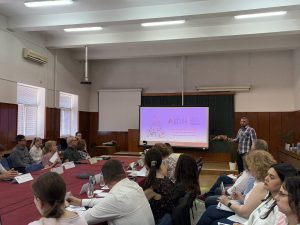
Detailed review of case studies:
- Veliko Tarnovo Regional Administration (Digital Twin in the Public Sector): A digital twin of the environment has been developed, which collects and analyzes data on air, water and climate conditions through IoT sensors and cloud technologies. The system allows for prediction and simulation of risk scenarios (e.g. floods or pollution), with management decisions now based on real-time data, not just retrospective analysis.
- ” Elna ” Ltd. ( Predictive Maintenance): By implementing IIoT sensors on a CNC machine and a 5-axis machining center, the machines themselves generate data about their condition – vibrations, temperatures and load. This allows for early detection of problems and a transition to predictive maintenance, which reduces downtime, improves capacity utilization and increases accuracy.
- ” Mechatronics ” AD (Data- driven production and rapid iterations): In conditions of production with small series and high variability , where every mistake is expensive, the company implements IIoT solutions for monitoring parameters in real time. This leads to shorter working times, less scrap and accumulation of a database for future AI analyses. In parallel, 3D printing in the company accelerates development through rapid iterations and visualization of details before actual production.
- “New Tech ” Ltd. (Design Optimization): The combination of 3D printers, CAD/CAM systems and analysis algorithms allows errors to be detected at the d
esign stage. This significantly shortens the time from idea to finished product and reduces the need for trial processing on expensive material. - ” Senstate” Technologies “ AD (Early Design Testing): The use of 3D printing, a laboratory extruder and a climate chamber allows testing of different materials and designs in the early stages. This makes development faster, cheaper and significantly more predictable.
- ” Technoles ” Ltd. (Algorithmic Mode Control): Data from a CNC lathe and a 5-axis machining center are analyzed through algorithms that assist in the selection of optimal operating modes. The effect is shorter processing time, fewer defects and higher accuracy, which directly affects cost and competitiveness.
- “STS Print ” AD (Quality Control and Sustainability): Using a test printer and spectrophotometer, precise adjustment of printing parameters is achieved even before serial production. This ensures stable quality, a lower rejection rate and optimized, sustainable use of materials.
The digital future and new regulations
In a broader context, digital transformation is already a condition for participation in the modern economy. Upcoming European regulations, such as the Digital Product Passport, will require precisely such traceability, structured information and digital processes along the entire value chain.
Conclusion
The workshop in Svi
shtov clearly demonstrates a key trend: artificial intelligence is no longer an abstraction, but a working and accessible tool in Bulgarian industry. Companies that implement it not only optimize their processes, but also build the ability to make better decisions – faster and with less risk.
“Those who use data today build their competitiveness tomorrow.” This was the strongest message of the event – that the digital future is no longer ahead, but is happening here and now.

This news item has been created with the financial support of the Research, Innovation and Digitalization for Smart Transformation Program 2021-2027, co-financed by the European Union through the European Regional Development Fund under project BG16RFPR002-1.002-0001 -C01 “Accelerated digitalization for SMEs in the Central Region through the creation and development of EDIH.” The Regional Innovation Center “Ambitious Gabrovo” bears full responsibility for the content of the document and under no circumstances can it be assumed that this document reflects the official position of the European Union and the managing authority.