

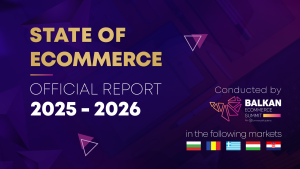
Online commerce in Bulgaria, Romania, Greece, Hungary, and Croatia continued to gain momentum throughout 2025, but the pace of this growth varies significantly between countries. These are some of the main conclusions in the report “The State of E-commerce in the Balkans in 2025,” prepared over nine months by the Balkan eCommerce Summit team. The study provides a detailed “snapshot” of how online business operates in the five markets of Southeast Europe and outlines expectations and trends for 2026.
The five countries are seeing growth in online revenue for 2025, but each is moving at a different pace. Based on the change in revenue on an annual basis (YoY) and the share of online sales, the ranking by development looks like this:
Hungarian participants are the undisputed leaders in growth.
- A full 75% of businesses report a jump in online revenue compared to the previous year.
- 41.7% sell entirely online, and another 12.5% say that more than half of their revenue comes from the internet.
- This combination of significant growth and a large segment of entirely online players puts Hungary at the top of the regional ranking.
Romania is almost catching up with Hungary in terms of both growth and digital dependency.
- 61.6% report year-on-year revenue growth.
- 34.6% are purely online businesses (100% revenue from e-commerce).
- Another 23.1% generate more than half of their turnover online.
- Romania is confidently expanding, with a large proportion of retailers there already structurally dependent on their online channels and viewing this as the norm rather than something new.
Croatia is the “golden mean” with stable but slightly uneven dynamics.
- Almost 60% of respondents report growth in online revenue, which is great news.
- However, just over 20% sell exclusively online. The good news is that more and more—40% now—generate most of their revenue there, and this trend is continuing.
- At the same time, around 45% of businesses still generate less than a quarter of their revenue online.
- This makes the Croatian market quite polarized—there are some very strong online players and others who still rely mainly on physical sales
Greece shows more moderate but still positive results.
- 52.8% report annual growth in online revenue.
- However, only 15.1% operate exclusively online, and 24.5% generate more than half of their turnover through Internet channels.
- For most Greek companies, e-commerce is important but not yet a major source of revenue. There are many opportunities for development in this area.
Bulgaria closes the ranking with a more diverse growth profile, but with an impressive segment of entirely digital brands.
- 45.7% of respondents report growth in online revenue.
- 34.6% operate 100% online, and another 19.7% generate more than half of their sales online.
- Although growth here is not as widespread as in Hungary or Romania, Bulgaria already has a solid core of “purely” online brands, which is an excellent basis for growth.
Mobile strategies: Optimization is a must, apps are a bonus.
Mobile-optimized websites dominate all five markets. Merchants rely on responsive design as the primary way to serve customers via phone. Native apps and PWAs exist everywhere, but they are rather the exception in terms of numbers. It seems that fast delivery, good service, and, of course, low prices and discounts are more important to the end customer. Whether the site is a PWA or a regular mobile version does not significantly affect them.
Trade without borders: The plans are big, but the reality is local.
Trade in the five countries remains predominantly domestic. In Greece and Bulgaria, over 40% of respondents do not sell abroad at all. In Croatia, Romania, and Hungary, most traders have no foreign customers or less than 10%. The data shows that international expansion is more a matter of good intentions than reality for now. Interestingly, in Hungary and Romania, where growth is strongest, there is also a higher percentage of companies with significant export revenues. It seems that the appetite for foreign markets comes with digital maturity and accumulated muscle in the local market. If you are looking for ways to develop this muscle even further and build a network of useful contacts, you know that there is only one place to go – Balkan eCommerce Summit 2026.
The challenges: We all face the same obstacles.
Despite our differences, the operational problems are the same everywhere. Customer acquisition and marketing are the biggest obstacles for all of us. Logistics and order fulfillment follow closely behind, especially for larger merchants. Issues such as payments, fraud, and software selection are also present, but not as critical as generating orders and scaling operations.
What’s coming in 2026?
Expectations are for continued growth, but with different ambitions. In Greece and Croatia, the focus will be mainly on consolidating positions in the domestic market. In Bulgaria, Romania, and Hungary, however, the larger players are already looking to expand regionally and even across Europe.
“The data clearly shows that the region is not moving as a package,” comments Nikola Ilchev, author of the study and organizer of the Balkan eCommerce Summit. “In 2026, success will not depend on where you are geographically, but on how smartly you use marketing, automation, and data in your decision-making.”
The State of eCommerce 2025 study will form the basis for discussions during Balkan eCommerce Summit 2026.