
The labour market in Gabrovo and the surrounding region continues to evolve dynamically, marked by high demand for skilled workers and significant difficulties in attracting suitable candidates. A recent survey conducted among 25 local companies reveals clear trends that affect both the industrial sector and the growing fields of IT, administration, and digital services.
High Demand for Technical, Engineering, and IT Specialists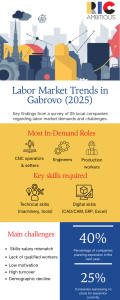
Most surveyed companies report an ongoing need for technical and production personnel, including CNC machine operators and setters, mechanics, technicians, engineers, and quality control specialists. Many manufacturing firms emphasise that these roles represent long-term needs rather than seasonal demand, with several companies seeking multiple employees at once.
At the same time, the IT sector in the region is also expanding and experiencing a shortage of qualified professionals. Employers are searching for Android, Java, .NET developers, database experts, and software engineers, yet finding suitable senior-level candidates is becoming increasingly challenging.
Demand is also strong for administrative, sales, and marketing professionals, such as accountants, digital marketing specialists, sales experts, and office assistants.
The Competencies That Matter Most
Employers place a strong emphasis on a combination of technical, digital, language, and soft skills. The most valued competencies include:
-
Technical proficiency, especially the ability to work with production machinery and tools.
-
Digital skills, including use of CAD/CAM software, ERP and CRM systems, and advanced Excel.
-
English language skills, particularly important for commercial, technical, and IT roles.
-
Soft skills such as responsibility, discipline, motivation, teamwork, and adaptability.
Many firms express readiness to train new employees, but expect at least basic technical literacy and a committed attitude toward the job.
Expansion Plans: Cautious Optimism
Based on the survey, companies in the region fall into three main groups:
-
Businesses planning to expand – mainly IT companies and manufacturers experiencing increasing production volumes (e.g., Pastili, STS Print, Avans).
-
Firms that would expand if qualified candidates were available – organisations whose growth is limited not by strategy but by workforce shortages.
-
Companies with no current plans to grow – often due to market uncertainty, reduced demand, or a stable workforce structure.
Overall, more than half of the surveyed employers are open to expanding their teams, though the shortage of suitable candidates frequently restricts this potential.
Key Challenges: Skill Shortages, Low Motivation, and Demographic Pressure
Nearly all companies report substantial difficulties in attracting the right employees. The main issues include:
1. Lack of qualified specialists
The shortage is most pronounced for CNC operators, mechanics, engineers, technologists, and experienced IT professionals.
2. Low motivation and inconsistent work discipline
Employers note problems such as reluctance to work shifts, low productivity, lack of initiative, and high employee turnover — particularly in production roles.
3. Demographic decline
The region faces a shrinking pool of young people and limited inflow of new workforce. Some firms mention that even when training is offered, it is difficult to find candidates willing to commit long-term.
4. Misalignment of expectations
Employers frequently encounter candidates who overestimate their skills, expect higher-than-justified wages, or possess limited practical experience.
What These Trends Mean for the Region
The survey illustrates that the labour market in Gabrovo is strongly worker-driven, yet many open positions remain unfilled. Industrial companies experience mounting pressure to find workers who combine technical skills with motivation and reliability. Meanwhile, the IT sector competes not only locally, but also nationally and internationally, further limiting access to experienced talent.
In the long term, the region would benefit from:
-
closer cooperation between educational institutions and businesses;
-
initiatives to retain and attract young professionals;
-
reskilling and upskilling programs;
-
broader adoption of modern technologies and digitalisation within companies.
Conclusion
The labour market in Gabrovo and the region is at a pivotal moment: businesses are growing, demand for talent is rising, yet workforce shortages remain a critical barrier. Companies are prepared to invest, expand their teams, and offer training, but achieving sustainable growth will require stronger preparation of the local workforce and more systemic support at both regional and national levels.